5 Tips to Improve Your Cat's Gut Health
From digestion to immunity, your cat’s gut health plays a major role in their overall health and happiness. Below are 5 simple and effective tips to help you care for the health of your cat’s intestine.
1. A balanced diet
An appropriate well-balanced diet for your cat’s metabolism is a great way to improve your cats’ gut health.
Therefore, choosing a diet adapted to your cat’s needs is a key factor: choosing a cat food specially formulated to help support your cat’s natural defences can help. Consumption of heat-treated lactobacilli has been proven to help support natural antibody production in your cat’s intestinal tract, while Omega-6 acids, and other selected nutrients, help support a healthy skin and a radiant coat.
On the contrary an unbalanced diet can be harmful for your cat’s gut health. Avoid all food that could be toxic (such as garlic, chocolate or avocado), food that could cause wind (e.g. cabbage beans) or food that could lead to weight gain (human food tidbits).
2. Grooming
Our cats love being pampered!! Make the most of it and groom them regularly: not only will you love hearing them purr, but by grooming them you will also help prevent them from ingesting large quantities of hair, which can cause constipation and affect your cats gut health.
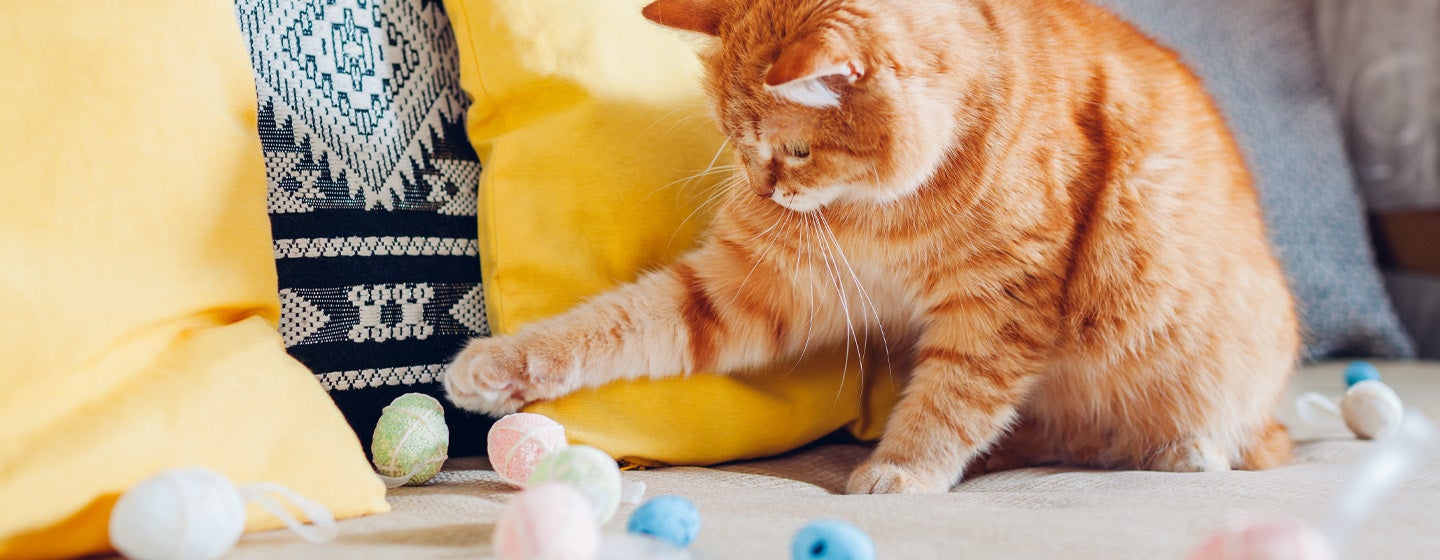
3. On your marks…Ready? Play!
Exercising holds many benefits: not only does it stimulate your cats intestine, which is useful for regular bowel movements, but it also helps you to keep your cat‘s weight and stress levels under control.
20 minutes of exercise daily, split into two different sessions, will boost your pet’s energy level and strengthen your relationship.
4. Take it easy
She who goes slowly, goes healthily: cats are particularly sensitive to diet changes and modifications. Should you change your pet’s food it is recommended to proceed step by step.
Bad Breath In Cats
If your feline friend is suffering from bad breath, often called halitosis, we recommend that you first take them for a check up from your vet. They will be able to examine your cat’s teeth and mouth to check there isn’t a serious issue causing your cat’s bad breath.
Keep reading to find out about the possible causes of feline halitosis.
Bathing Cats: Everything You Need to Know
Cats don’t usually need baths, but there are some exceptional circumstances. If they’re rolled in something that they can’t wash off themselves, or they have long hair which has become matted, a bath might be a good idea.
Most cats really dislike baths and they can find the experience very stressful. If you’re able to, just clean an isolated area, rather than getting their entire body wet.
That said, there are rare occasions when bathing your cat is unavoidable, in which case there are ways to make the experience more comfortable for both of you. However, if your cat needs a bath because they’ve come into contact with toxic substances, take them to the vet first.
Before you bathe your cat
Get everything you need in one place, so that once you’ve started bathing your cat, everything is within easy reach. You’ll need:
• A large plastic bucket, sink or bath (lined with a non-slip floor mat) to use as a cat bath.
• Specialist cat or kitten shampoo. Find a mild all-rounder with no harsh chemicals or perfumes. Never use human shampoo, as it’s unsuitable for cat hair and skin due to the difference in p
H levels.
• A cat conditioner if required. Again, don’t use conditioner for human hair.
• A towel or two.
• A brush to help remove matts and knots.
Bathing your cat
Blood in Cat PooAOA_CENMKTG_PU_Website Article_Blood_in_Cat_Poo_1440x560px.jpg5 mins read<p>Your cat’s poop is a great indicator to let you give you a good indicator as to their health, know how their body is functioning, and to ensure that everything’s normal.</p><br />
<p>Normally, your cat’s poop will appear firm and brown in appearance, but if you start noticing any unusual changes – especially light to dark red flecks in their feces it can be a sign of a larger problem.</p><br />
<p>Blood in cat poo can have many different causes, including everything from stress to a more life-threatening health issue. We’ve created this handy guide to tell you all you need to know about blood in cat poo, from the possible causes to the treatment options available.</p><br /></p>
Your cat’s poop is a great indicator to let you give you a good indicator as to their health, know how their body is functioning, and to ensure that everything’s normal.
Health
Cat Acne: Treatment And Prevention
Cats are susceptible to developing acne just as us humans. Here is what you need to know if you start noticing stubborn pimples that won’t go away.
Unfortunately, acne is not a problem reserved for humans. Cat acne also exists and can affect felines quite often. Although it’s still unclear why it develops, there are a few things a cat owner should know to help their pet get back to their normal self. Keep reading to find out how feline acne manifests and what cat acne treatment is most effective in alleviating the condition.
What is cat acne?
Cat acne, or follicular keratinization as it’s officially known, forms when the hair follicles are blocked due to an excessive production of keratin, a protein found in the skin. In cats, acne mostly forms around the chin area, which is why it’s commonly referred to as cat chin acne.
What does cat acne look like?
Cat acne manifests itself as small bumps accompanied by blackheads or whiteheads, similar to humans. But on a cat’s skin it can often take an appearance that looks more like dirt than pimples, which is why many owners don’t even notice the skin condition. Severe cases can lead to hair loss, redness and even bleeding.
What causes cat chin acne?
The causes of cat acne are still largely a mystery. It is believed that plastic can encourage the breakout as it’s been mostly noticed in cats that use plastic bowls for food and water. Poor grooming, especially in older cats, can also lead to acne. But there are a series of underlying conditions that can have a contribution as well:
• Poor immune system.
• Stress.
• Food allergies.
• Hormone imbalances.
• Hyperactive sebaceous glands.
Cat Dental Care
Dental disease in cats is one of the most common conditions seen by vets today. It can also be very painful, especially if left untreated. However, the good news is that – unlike many health problems – it is usually preventable through proper dental care for cats.
Cat Fleas: Causes, Prevention and TreatmentCat Fleas - Causes, Prevention and Treatment (1).jpg8 mins read<p>Cat fleas are very normaland they’re the most common reason for a cat to develop a skin problem.</p><p> </p>
Cat fleas are very normal and they’re the most common reason for a cat to develop a skin problem.
Health
Cat Flu: Symptoms, Treatment and Long-term Effects
Flu in cats can be just like human flu: symptoms include a runny nose and achy muscles, and plenty of TLC is needed for recovery. Learn how to spot the signs and symptoms of flu and how it can be treated.
What are the symptoms of cat flu?
If you’ve ever been hit with the flu, you will have some sympathy for your cat. The illness isn’t all that different to the human variation. Just like in people, most cats can fight it off; however, for more elderly animals, kittens, or cats with an underlying condition, it can be more serious. Cat flu is generally viral, meaning that in most cases antibiotics won’t be effective.
Luckily there are vaccinations available. Although it’s not a guaranteed defence, vaccinating your cat will go a long way toward protecting them, particularly if you’re planning a trip to a cattery or any environment in which groups of cats are kept together.
What is cat flu?
Whether they’re sneezing or sniffling, the symptoms of cat flu can be fairly easy to identify once you know what you’re looking out for. Here’s a list of some of the more common signs to be aware of:
• Sneezing: this is the main way in which the illness is spread. Just a few droplets from an infected cat’s sneeze can carry a distance of metres.
• Runny nose.
• Watery eyes.
• Difficulty with, or noisy, breathing.
• Dribbling.
• Change in behaviour.
• Loss of appetite.
• High temperature.
• In serious cases, ulcers around the eyes.
Symptoms can range vastly in severity: whereas one strain of the virus might only result in a bit of sneezing and a runny nose, another can lead to life-threatening complications.
However mild or serious the signs, don’t take a risk. As soon as you spot cat flu symptoms, take your pet to see the vet.
Cat skin problemsCat skin problemsHERO.jpeg6 mins read<p>Your cat’s skin is a good general indicator of their health. It should be pink or black (depending on the breed) and their coat should be smooth and shiny.</p><p> </p>
<p>Watch out for crusting, itching, scaling, black or white spots, bald patches and inflamed areas, as this is usually a sign that something’s not right. For example, small black dots could indicate fleas while a dull coat might suggest an underlying illness. Scratching and scabbing, meanwhile, could mean your cat has a skin disease. Pay attention to the skin around your cat’s ears, too. Any brownish discharge or redness should be investigated by your vet.</p><p> </p>
<p>If you know what warning signs to look out for on your cat’s skin, you can help them get treatment as soon as you spot something that doesn’t seem quite right.</p><p> </p>
<hr><br><h3>Dry skin in cats</h3><p> </p>
<p>Dry skin isn’t usually a serious health issue for cats, unless they’re continually scratching. The temperature of your home can affect their skin - dry skin can soon become itchy during winter when the heating is turned on. A humidifier might help your cat keep comfortable if this is a problem.</p><p> </p>
<hr><br><h3>Common skin parasites</h3><p> </p>
<p>Common skin parasites on cats include fleas, ticks and mites. They can cause itchiness, inflammation and skin lesions, as well as hair loss. In some more serious cases, a heavy flea infestation can cause anaemia in kittens, which can be dangerous to their health. Fleas can also cause a specific allergy in cats known as flea allergy dermatitis (FAD - see below for more information). Most cat skin conditions involving parasites can be treated quickly, although some may require longer-term treatment.</p><p> </p>
<hr><br><h3>Identifying cat fleas</h3><p> </p>
<p>Cats are very good at grooming themselves, so owners are sometimes surprised to learn that their cat has fleas! Many cat skin conditions can be the caused by fleas, and the most obvious sign that the pesky parasites have taken up residence on your cat is persistent scratching, although some cats won’t scratch themselves but instead over-groom, sometimes leaving bald patches.</p><p> </p>
Your cat’s skin is a good general indicator of their health. It should be pink or black (depending on the breed) and their coat should be smooth and shiny.
Health
Cat Ticks: Causes, Signs and Treatment
Ticks can be a painful problem that your cat may have to face. Find out how to prevent and treat cat ticks below.
Introduction to cat ticks
There are two different groups of ticks to watch out for, hard ticks and soft ticks. Hard cat ticks often look like a sunflower seed; they are also recognisable by the hard shield found just behind their mouthparts. Hard ticks are the type of ticks you will usually find on your cat.
Soft ticks are the second type of group of tick. Instead of looking like a seed these ticks look like a raisin. These kinds of ticks are not usually found on cats, as they tend to feed on other animals instead such as birds or bats.
What are cat ticks?
Ticks are a kind of parasite. Ticks bite beneath a cat’s skin and suck blood back into their bodies. Unfed ticks are tiny, have eight legs, and can be black, brown, red or tan, but once they attach themselves to your cat they can swell up to the size of a pea as they fill with blood. Cat ticks are actually classed as arachnids instead of insects, which is a key difference between them and the flea. Ticks can pass disease onto an animal it feeds on; this is why tick prevention steps are an important measure to take when looking after a feline.
How can my cat catch ticks?
There are a number of different ways your cat can catch ticks. The first and the most likely is from other animals. Cats often interact with other animals once they leave the house. Ticks can find their way from one animal onto your cat very easily. If you are worried about cat ticks we advise you not to leave food outside your house, as this can encourage other animals to enter your cat’s territory.
If you tend to go on walks outside in fields or woodland areas ticks could find their way onto your clothes easily. This is because they tend to cling onto the top of branches and blades of grass, when you then brush past them they cling onto your hair and clothing. This means even indoor cats are in dangers of catching ticks, so whether your cat travels outside or not tick prevention is still something you should be aware of and do.
Another way your cat can catch ticks is just from exploring outside. Ticks can survive outside when not on a host. They can just as easily cling to a cat’s fur as they can to your clothing.
Cat urinary tract problems
If you’ve noticed that your cat is having problems urinating, it may be down to feline lower urinary tract disease (FLUTD). This is a broad term that’s used to describe a number of urinary tract conditions that affect cats’ bladders and urethras.
The most common condition results in inflammation of the bladder (cat cystitis) and, in male cats, similar symptoms accompanied with an obstruction of the urethra (the tube from the bladder to the outside). This condition, known as idiopathic cat cystitis, is unfortunately both common and complex and, as symptoms can be medical and/or behavioural, you won’t always know exactly what’s triggered it.
Cats can get urinary problems which prevent the bladder from emptying properly and, when not treated quickly this could cause a blockage of the urethra. These urinary problems are most commonly caused by feline lower urinary tract disease (FLUTD). Unlike the name suggests, FLUTD is not actually a specific type of disease, but an umbrella term for conditions that affect the urinary bladder and/or urethra in cats.
Potential causes of feline lower urinary tract disease (FLUTD)
There are numerous issues that may cause FLUTD, some of the most common causes are:
Diabetes in CatsDiabetes-in-CatsHERO.jpg5 mins read<p>Diabetes in cats is a long-term condition, but it needn’t have an impact on your kitty’s quality of life. Find out what to do if you suspect your cat has diabetes and how to manage it with our guide.</p><br />
<p>Diabetes in cats is generally nothing to worry about – this long-term condition can certainly be managed with treatment, and it doesn’t need to impact hugely on your pet’s quality of life. In fact, with a little extra TLC, your cat will be back on all four paws before you know it. They’ll probably be causing mischief, getting attention from visitors, and escaping trouble just as they used to!</p><br />
<p>If you have a cat with diabetes or simply want to find out more about the condition, read on to find out all you need to know, including the various cat diabetes symptoms to look out for.</p><br /></p>
Diabetes in cats is a long-term condition, but it needn’t have an impact on your kitty’s quality of life.
Health
Feeding & Nutrition
Diarrhoea in cats
If you notice that your cat is going to the litter tray more often than usual, their stool is more liquid, or it has an increased volume compared to normal, then they may have diarrhoea.
Diarrhoea in cats is an increase in the frequency, volume, or liquid content of faeces, leading to unformed or loose stools. The consistency of your cat’s diarrhoea can vary from soft but formed through to liquid/watery, and the colour can be darker or lighter than normal stools or even green, red or yellow.
If you think your cat has diarrhoea, it’s important not to panic. Most of the time the condition is temporary and not serious, and is usually solved quickly with a simple change of diet or appropriate medical treatment from your vet. The severity and the duration of diarrhoea episodes vary depending on the underlying cause.
Diarrhoea in cats is usually classified as either:
• Acute (sudden onset and short lived) or chronic (more than 2-3 weeks duration)
• Persistent (constant) or intermittent (i.e. comes and goes)
As you can imagine, the most serious of cases are chronic and persistent.
Causes of diarrhoea in cats
Diarrhoea in cats can occur for a wide variety of different reasons. Some possible causes include:
FIV in Cats
Feline immunodeficiency virus (FIV) is a major viral infection in cats. Although it is similar to HIV (AIDS) in people, FIV is species-specific, which means it can only be transmitted from cat to cat, not to humans or other animals. This is why it can also be known as ‘Feline AIDS’.
What is FIV?
Feline immunodeficiency virus (FIV) is a lentivirus. Lentiviruses typically only cause disease slowly and thus infected cats may remain healthy for many years before showing signs of disease. Once a cat has been infected with FIV, the infection is usually permanent and needs to be managed rather than cured.
How can my cat contract FIV?
FIV is present in the blood and saliva of infected cats but as it cannot survive for long outside the body and requires a high dose to cause an infection, it is not easily transmitted from cat to cat.
The most frequent way FIV is spread is through a bite from another cat, when the virus in the saliva of an infected cat is introduced directly into the blood of the cat it bites. For this reason, male cats that fight often are most likely to be infected.
As the virus cannot be transmitted via food, feeding bowls, bedding or hands, the virus spreading within groups of cats which do not fight is highly unlikely. Occasionally infection is transmitted from an infected mother cat to her kittens during the birthing process or via her milk. Sexual contact is not a major means of spreading FIV in cats.